
IFRS 18 software: presentation and disclosure, ready for 2027
IFRS 18 replaces IAS 1 and changes the statement of profit or loss for every IFRS reporter. This guide explains what changes, how transition works, and how Presvana, a free IFRS 18 transition tool, turns a trial balance into the new statement.
What is IFRS 18?
IFRS 18 Presentation and Disclosure in Financial Statements was issued by the IASB in April 2024. It replaces IAS 1 Presentation of Financial Statements and applies to annual reporting periods beginning on or after 1 January 2027, with earlier application permitted. It does not change recognition or measurement. It changes how performance is presented, so profit or loss is more comparable between companies.
IFRS 18 effective date and transition
IFRS 18 applies retrospectively. For a calendar-year company, the first IFRS 18 annual statements are for the year ending 31 December 2027, and the 2026 comparatives must be restated on the IFRS 18 basis. In practice that means 2026 figures need to be classified under the new rules as well.
On transition, companies disclose a reconciliation for each line item in the statement of profit or loss between the restated comparatives and the amounts previously presented under IAS 1. Interim reports in the first year are affected too.
Three big changes to profit or loss
1. New categories and subtotals
Income and expenses are classified into five categories:
- Operating: the default category, covering income and expenses not classified elsewhere
- Investing: for example, returns from investments such as associates and joint ventures accounted for using the equity method, and from cash and cash equivalents
- Financing: for example, interest on borrowings and other liabilities that arise from financing
- Income taxes
- Discontinued operations
Two new subtotals are required: operating profit and profit before financing and income taxes. Companies whose main business is investing or providing finance, such as banks and insurers, follow specific classification rules.
2. Management-defined performance measures (MPMs)
Many companies report adjusted profit figures in results announcements. Where these are subtotals of income and expenses used in public communications, IFRS 18 calls them MPMs. They must be disclosed in a single note, explaining why each measure is useful, how it is calculated, and reconciling it to the most comparable IFRS subtotal, including the tax and non-controlling interest effects.
3. Aggregation and disaggregation
IFRS 18 adds principles for grouping items with shared characteristics and splitting items that differ, in the primary statements and in the notes. Labels such as "other expenses" should be avoided where a more informative description is possible. Companies presenting operating expenses by function must disclose specified expenses by nature in the notes: depreciation, amortisation, employee benefits, impairment losses and inventory write-downs.
Related changes
IFRS 18 comes with consequential amendments to other standards. In IAS 7, operating profit becomes the starting point for the indirect method of reporting operating cash flows, and the choices for classifying interest and dividends are largely removed for most companies.
IFRS 18 checklist for finance teams
- Map every profit or loss account to an IFRS 18 category
- Restate the comparative year and prepare the line-by-line transition reconciliation
- Identify any MPMs used in investor communications and draft the note
- Decide on presentation by function or by nature, and gather the by-nature disclosures if needed
- Review aggregation and labels such as "other"
- Update the cash flow statement for the IAS 7 amendments
Presvana - IFRS 18 Reporting
A free Windows app that turns a trial balance into an IFRS 18 statement of profit or loss.
- Trial balance import from Excel and CSV, with a guided wizard
- Map each account once into the five IFRS 18 categories
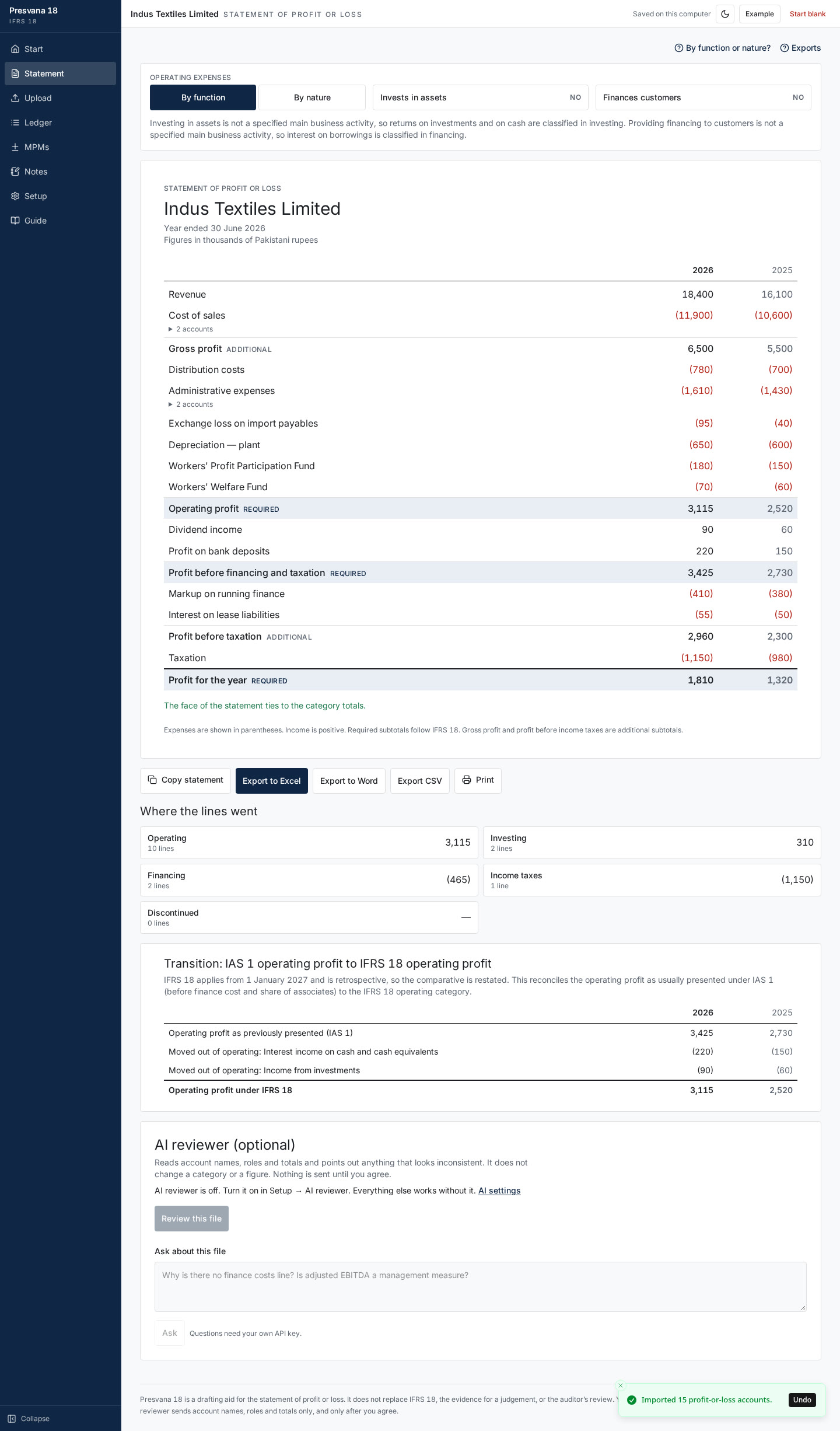
- Operating profit and profit before financing and income taxes, built automatically
- Expenses by function or by nature
- MPM notes with reconciliations to the IFRS subtotals
- Prior-year comparatives and the IAS 1 to IFRS 18 transition reconciliation
- Export to Excel and Word
- Saved mappings for next year, plus backup and restore
- Optional AI checks that flag accounts that look misclassified
- Works offline; your figures stay on your PC
Presvana provides presentation tools; review results with a qualified professional. Also see our IFRS 16 software guide and IFRS accounting software.
Frequently asked questions
When is IFRS 18 effective?
IFRS 18 Presentation and Disclosure in Financial Statements applies to annual reporting periods beginning on or after 1 January 2027. Earlier application is permitted. It replaces IAS 1.
Do I need to restate comparatives under IFRS 18?
Yes. IFRS 18 is applied retrospectively, so the comparative period has to be restated and presented on the new basis, with a reconciliation of the restated comparatives back to the IAS 1 presentation.
What are the new categories in the statement of profit or loss?
Income and expenses are classified into five categories: operating, investing, financing, income taxes and discontinued operations. Two new required subtotals follow: operating profit, and profit before financing and income taxes.
What are management-defined performance measures (MPMs)?
MPMs are subtotals of income and expenses that a company uses in public communications outside the financial statements to show management's view of performance, such as an adjusted operating profit. IFRS 18 requires them to be disclosed in a single note, with a reconciliation to the most comparable IFRS subtotal and the tax and non-controlling interest effect of each reconciling item.
What changes for aggregation and disaggregation?
IFRS 18 sets principles for grouping items by shared characteristics and splitting them when they differ, so material information is not obscured. Companies that present operating expenses by function must also disclose specified expenses by nature in the notes, such as depreciation, amortisation, employee benefits, impairment and inventory write-downs.
Does IFRS 18 change recognition or measurement?
No. IFRS 18 is about presentation and disclosure. It does not change how items are recognised or measured, but it does change how profit or loss is structured and what is disclosed. It also makes consequential amendments to other standards, including IAS 7 statements of cash flows.
Is there free IFRS 18 software?
Yes. Presvana - IFRS 18 Reporting is a free Windows app on the Microsoft Store that turns a trial balance into an IFRS 18 statement of profit or loss, with MPM notes, comparatives and the IAS 1 to IFRS 18 transition reconciliation.
Does my data leave my PC with Presvana?
No. Presvana works offline and keeps your data on your PC. Only the optional AI checks send a summary of account names and totals to an AI provider, and only when you run one.
Get ready for IFRS 18
Build your first IFRS 18 statement and transition reconciliation from a trial balance, free.